—David Menconi, Down on Copperline
Hillsborough singer/songwriter Jonathan Byrd has always been more than just a musician, working the multi-task hustle on a variety of fronts. But this year has still found him moving into some shockingly unexpected areas.
Most ambitious and least expected, Byrd has gone back to school as a fulltime student to study physics at NC State University. He’s taking 13 hours of classes this semester, which requires him to make the drive over to Raleigh from Hillsborough every weekday. Byrd turns 55 years old this month, which makes him older than all his fellow NC State students and even some of his teachers, too.
An enthusiast by nature, Byrd finds the study of physics just as inspiring as writing and recording music. It doesn’t take much to get him talking about the finer points of cosmic microwave background, Michelson interferometers and Schrödinger’s equation.
“There’s a lot of days when I think I might be the only person in class who feels like I get to be there, not that I have to be there,” Byrd says. ”It’s an opportunity I’m so grateful for. A lot of work and driving, but overall a great sense of gratitude to get to be good at one more thing.”
One of many reasons why this development is so unlikely is the fact that Byrd’s high-school career was, by his own admission, “a total nightmare.” It was the 1980s and he had ADHD (Attention-deficit/hyperactivity disorder), which would go undiagnosed until adulthood.

“Nobody knew what to do with me, and I didn’t know how to be a good student,” he says. “So I was a smart kid with a lot of problems. I’d never do homework, then make 100 on a test just to flip my teachers the finger, show them I was smart and didn’t have to work. I did not know who to blame for my failure as a student.”
Eventually, being diagnosed with ADHD and getting on a medication regimen was “a revelation.” In the meantime, Byrd went on to a successful career as a professional musician with numerous albums to his credit. He got through the Coronavirus pandemic better than most musicians, with weekly “Shake Sugaree Americana Residency” online broadcasts from Chapel Hill nightspot The Kraken and teaching online songwriting lessons.
Post-pandemic, Byrd was pondering new horizons when his girlfriend suggested a community college class. He took pre-calculus and did well enough to attract the attention of NC State’s Community College Collaboration (C3) program, which recruits non-traditional students. There was a meeting, and Byrd was asked what he wanted to do.
“As a songwriter, I’m used to saying stupid things out loud,” he recalls. “So I said the dumb thing: ‘I’d love to study physics.’ Great, they said, keep your grades up and you can transfer to NC State. I was walking around after that going, ‘Did that just happen?’ And here I am.”
The work schedule is demanding enough that Byrd has had to dial his music career way, way back. He still posts on his Substack, and current projects include transcribing the music of the late English folkie Nick Drake’s 1972 landmark album “Pink Moon” for his Patreon supporters. And he’s got one-and-a-half unreleased albums recorded, which he hopes to release before too long. But don’t expect to see him performing live on a stage anywhere before summer 2026 at the earliest.
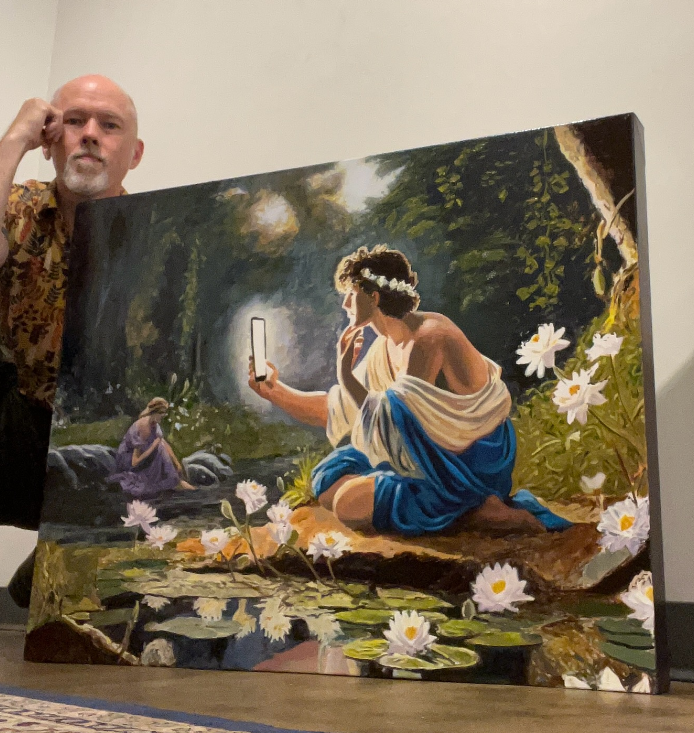
In the meantime, another artistic pursuit has emerged for Byrd. He’s taken up painting, with work on display at spots including Thomas Stevens Gallery in his Hillsborough hometown. One of the attractions of painting is it just fits his schedule better right now.
“Music exists in time, so you have to be present to make it or take it in,” Byrd says. “There’s a process of creating music – writing, recording, pitching it. Whereas with painting, if I’ve got 10 minutes I can put paint on canvas. That creative act is currently more accessible because of the time I have to do it.”
As for what Byrd’s life, work and career might look like in future semesters and beyond, he is still figuring that out.
“The first question everybody asks is, what will you do with this?” Byrd says. “I don’t have a specific goal in mind. When you’re 20 or even 30, you might think about your legacy in the world. But that’s not where my head’s at. I just want to be around good people doing cool stuff. People throw the word ‘talented’ around, and if I am, it’s from writing six to eight hours a day. I don’t think any songwriter, probably not even Paul McCartney, feels like they’re always great. But put in the time and you’ll get good at it. A lot of what gets called talent is just that.”